
Thursday, February 11, 2010

Wednesday, February 3, 2010

Friday, January 29, 2010

Monday, January 4, 2010
Fat Burning Weight Training

My weight training has generally been focused on muscle gain (hypertrophy) or strength training.
But the third type – fat burning – hasn’t ever been a priority for me. I do my fat burning through diet and cardio. In fact, part of the reason I do hypertrophy training is to prevent muscle loss from my running.
I’ve been really pushing myself over the past 3 months with heavier weights. And my joints are screaming.
But I’m getting ready for the Oklahoma City Marathon on the 26th of this month. So I decided now would be a good time to try a fat-burning weight training program.
Wow – these workouts are kicking my butt. It’s so intense, but a different kind of intense compared to lifting heavy stuff. But I’m getting ahead of myself…
Why go with a fat-burning weight training program now?
Well, a good fat-burning-with-weights program should:
1) use lower weight, so the joint stress is lower; I want stress-free joints entering the marathon
2) involve grueling workouts, really testing your endurance; and I want maximum endurance for the marathon
3) supposedly burn fat right?; well lower fat means I’ll be a little lighter for the marathon and that should make it a little easier
4) relieve a slight boredom that’s been creeping into my workouts since I’ve been on the same routine for about 8 weeks now…
What Is a “Fat Burning” Weight Training Program?
Ed Note: Long after writing this, I have released my exact routine for $10 available here.
There are so many programs on the market for using weights to burn fat. Some of the more popular come from Craig Ballantyne’s Turbulence Training program. Also, in New Rules of Lifting (one of the best weight lifting books you can buy – it’s a physical book), they present some. Each of those resources are like $10 or so. For the ladies: New Rules of Lifting For Women.
The basic ideas of how to make a program to burn fat through lifting weights are:
•12 to 15 reps per set
•lighter weights (related to the first bullet of course)
•not training to failure on a set but going for overall fatigue
•little to no rest between sets
•full-body workouts (not splitting muscle groups from day to day)
Depending on whose program you jump into, there may be cardio components as well. (That’s my one criticism of the aforementioned books’ programs – they eschew most cardio.)
And trust me, you won’t burn fat with a poor diet. That’s made really clear in both The Truth About 6-Pack Abs and in Burn The Fat, Feed The Muscle.
But these are just the basic principles. Once you get to an advanced experience with weight training, you can put together your own programs. So that’s what I did.
What Is My Routine?
This would become a really long post if I provided my exact program but here is the main outline:
•I triple-set with unrelated muscle groups
•I used this as an opportunity to add in some exercises I usually don’t do (this ads some fun to the workout)
•It’s a 4-day a week program, each day different
•While each one is full body, I do emphasize slightly different muscle groups on each day
•I still include my running – after all, I’m training for a marathon!
The Big 7 – The Seven Most Important Weight Training Exercises
This is a short article to set in stone the 7 most important weight lifting/weight training exercises. I’ve mentioned them several times in various posts, and also in several of my ebooks, but let’s get this defined once and for all.
Note – these are not necessarily in order. We’ll save the debate about which “one” is the most important for later…
The Big 7
1.Squat
2.Deadlift
3.Chest Press (Bench Press)
4.Rows
5.Chin-up/Pull-up
6.Military/Standing Pres
7.Dips
There are many variations to each of these. Dumbbell versions, barbell versions, seated vs. standing, different grips, different angles, etc.
But the key things about this list:
a) they are all compound movements, not isolation exercises
b) together, they hit every major muscle in the body (yes, they even work your abs for you fitness-models out there!)
c) they produce RESULTS
d) they should form the basis of any good program/routine; if your routine doesn’t include each of these at least once a week, even if you are a beginner, get a new program
e) with the variations, you could do just these 7 exercises for years and never get bored
Note – these are not necessarily in order. We’ll save the debate about which “one” is the most important for later…
The Big 7
1.Squat
2.Deadlift
3.Chest Press (Bench Press)
4.Rows
5.Chin-up/Pull-up
6.Military/Standing Pres
7.Dips
There are many variations to each of these. Dumbbell versions, barbell versions, seated vs. standing, different grips, different angles, etc.
But the key things about this list:
a) they are all compound movements, not isolation exercises
b) together, they hit every major muscle in the body (yes, they even work your abs for you fitness-models out there!)
c) they produce RESULTS
d) they should form the basis of any good program/routine; if your routine doesn’t include each of these at least once a week, even if you are a beginner, get a new program
e) with the variations, you could do just these 7 exercises for years and never get bored
Muscle Memory – Can Muscles Actually “Remember”?
Ask any bodybuilder what muscle memory means and they will readily answer that it is the ability to regain muscle mass more quickly after a period of inactivity than it took to gain the same mass originally. However, if you type the term “muscle memory” into a search engine on the internet, you will find there are many different interpretations of this term. And depending on which authority you consult, the meanings are diverse.
Some believe that muscle memory is simply the application of learned processes much like a baby learns to walk or feed itself. After many repetitions of the same action, parts of the body are able to react without the person thinking about what they are doing, and the action involved seems to come naturally. If this is true, then muscle memory is actually a neurological function that is built into all humans. According to Andersen, et al. (2005), some studies have shown that neurological and physiological changes occur during skill training, but not during strength training alone. Others believe that there is an actual physiological change that occurs in the muscles during strength training, altering the function of certain muscle fibers, causing them to bring about muscle growth more readily than before training. In both cases, the muscle’s ability to regain both strength and size may be enhanced if training is stopped for a period of time and then started again.
Subscribe Today
so that you can be sure not to miss any of our latest tips to help you look and feel better. I'll throw in our ebook 3 Months to a New You when you subscribe!
First Name:
Primary Email:
Resistance training and weight training require a combination of strength and motor skill. As a person learns how to perform certain exercises, it is important to learn the right patterns of movement that will achieve the desired muscle growth (Jensen, Marstrand & Nielsen, 2005). Many people define muscle memory as muscular hypertrophy, kinesthesia, proprioception or a result of neuromuscular facilitation. To some extent, all of these definitions play a part in muscle memory. Let’s start by defining these terms and showing their interaction with one another to facilitate “muscle memory” during strength training and bodybuilding (as well as other types of exercise).
Muscular Hypertrophy
Hypertrophy is the increase of the size of an organ or select area of tissue that occurs due to an increase in the size of cells. Muscular hypertrophy occurs through increased contractile proteins. Myosin heavy chain isoforms, or MHCs, refer to the types of protein seen in a given muscle fiber.
MHCs determine how the muscle fiber functions. There are two types of MHCs – IIX, which are neutral until they are put to use by the muscle, and IIA, which have a specific purpose of causing muscle growth. Certain MHCs undergo a change in response to resistance exercise and serve as a reservoir of sorts for muscle hypertrophy because they can transform themselves into the types of fibers which grow easily in response to training (Haycock, 2004). Many scientists believe that once these types of muscle fibers are generated by regular resistance or weight training, they remain in the muscle, waiting to be reactivated. If a person does not exercise, or detrains, for a long period of time, and then begins an exercise regimen again, the fact that there are an abundance of muscle-growing fibers already present from previous workouts helps to regain muscle more quickly the second time around. In fact, certain types of strength training advocate detraining for a period of time in order to facilitate this type of response in the muscle, therefore eliminating the possibility of hitting a plateau that is difficult to overcome (Haycock, 2002; also see our post for “hardgainers“). Without that plateau, a bodybuilder is better able to continue growing in muscle size and strength.
Kinesthesia
Kinesthesia is the body’s ability to sense the position and movement of all parts of itself, such as limbs and muscular tension. For example, if a person closes their eyes and holds their arms straight out in front of them, they are able to tell without looking if their palms are facing up or facing down. For a bodybuilder this translates into the body’s ability to know the precise location and position to stop during a repetitive exercise in order to achieve the right amount of flex and tension to maximize the results. If you’ve taken part in a good program of resistance training, you will retain the ability to repeat the correct movements even if you stop training for a while.
It is important to note, however, that learning the correct way to perform an exercise is the key to achieving the best results. If a person learns the wrong movements, they will not achieve the same results. It is best to use a personal trainer or receive some sort of instruction when learning to exercise the different muscle groups, because learning the wrong form can cause damage or result in a workout that does not meet the exerciser’s goals. [Check here for the proper form videos for many major exercises; or here for the best weightlifting form for various muscle groups.] And the time and effort involved in unlearning bad technique can be substantial and can totally demoralize the individual.
Proprioception/Neuromuscular Facilitation
Proprioceptive Neuromuscular Facilitation is the term used to describe stretching exercises that increase range of motion in a muscle, thereby increasing strength and flexibility. It is often used as therapy after an injury or long periods of inactivity such as bed rest. By stretching and contracting and rotating a muscle, sufficient use can be regained even though the muscle has not been used as much as it would be normally, thus allowing a person to regain normal function. Stretching is an important part of physical fitness because it prepares the muscles for the physical activity involved in performing certain movements. It can reduce muscle strain and the danger of injury during a workout session. In order to be in top physical condition, a person must have good flexibility. Of course, there are different types of stretching for different routines (see our previous post on stretching for strength training).
Is Muscle Memory a Myth or Fact?
Many articles and studies exist that discuss whether muscle memory in relation to bodybuilding and weight training is a myth. Some experts believe that muscle memory is simply a normal function of the body, that it is more related to the way the brain sends signals when performing any movement. However, we’ll use the term to define the memory of a learned pattern of behavior, such as how to make the correct movements while performing resistance training exercises to obtain optimum benefit.
Based on my interpretation of the literature, as well as my own experience, muscle memory is real and does have an impact on a person’s ability to regain muscle mass quickly after a period of no exercise when they previously practiced a regular exercise regimen. A good analogy is learning to ride a bicycle or learning how to swim – once a person learns how to do these things, even if they don’t do them for a long period of time, they are able to operate the pedals and retain their balance on a bicycle, or kick their feet and rotate their arms to stay afloat when swimming.
Some believe that muscle memory is simply the application of learned processes much like a baby learns to walk or feed itself. After many repetitions of the same action, parts of the body are able to react without the person thinking about what they are doing, and the action involved seems to come naturally. If this is true, then muscle memory is actually a neurological function that is built into all humans. According to Andersen, et al. (2005), some studies have shown that neurological and physiological changes occur during skill training, but not during strength training alone. Others believe that there is an actual physiological change that occurs in the muscles during strength training, altering the function of certain muscle fibers, causing them to bring about muscle growth more readily than before training. In both cases, the muscle’s ability to regain both strength and size may be enhanced if training is stopped for a period of time and then started again.
Subscribe Today
so that you can be sure not to miss any of our latest tips to help you look and feel better. I'll throw in our ebook 3 Months to a New You when you subscribe!
First Name:
Primary Email:
Resistance training and weight training require a combination of strength and motor skill. As a person learns how to perform certain exercises, it is important to learn the right patterns of movement that will achieve the desired muscle growth (Jensen, Marstrand & Nielsen, 2005). Many people define muscle memory as muscular hypertrophy, kinesthesia, proprioception or a result of neuromuscular facilitation. To some extent, all of these definitions play a part in muscle memory. Let’s start by defining these terms and showing their interaction with one another to facilitate “muscle memory” during strength training and bodybuilding (as well as other types of exercise).
Muscular Hypertrophy
Hypertrophy is the increase of the size of an organ or select area of tissue that occurs due to an increase in the size of cells. Muscular hypertrophy occurs through increased contractile proteins. Myosin heavy chain isoforms, or MHCs, refer to the types of protein seen in a given muscle fiber.
MHCs determine how the muscle fiber functions. There are two types of MHCs – IIX, which are neutral until they are put to use by the muscle, and IIA, which have a specific purpose of causing muscle growth. Certain MHCs undergo a change in response to resistance exercise and serve as a reservoir of sorts for muscle hypertrophy because they can transform themselves into the types of fibers which grow easily in response to training (Haycock, 2004). Many scientists believe that once these types of muscle fibers are generated by regular resistance or weight training, they remain in the muscle, waiting to be reactivated. If a person does not exercise, or detrains, for a long period of time, and then begins an exercise regimen again, the fact that there are an abundance of muscle-growing fibers already present from previous workouts helps to regain muscle more quickly the second time around. In fact, certain types of strength training advocate detraining for a period of time in order to facilitate this type of response in the muscle, therefore eliminating the possibility of hitting a plateau that is difficult to overcome (Haycock, 2002; also see our post for “hardgainers“). Without that plateau, a bodybuilder is better able to continue growing in muscle size and strength.
Kinesthesia
Kinesthesia is the body’s ability to sense the position and movement of all parts of itself, such as limbs and muscular tension. For example, if a person closes their eyes and holds their arms straight out in front of them, they are able to tell without looking if their palms are facing up or facing down. For a bodybuilder this translates into the body’s ability to know the precise location and position to stop during a repetitive exercise in order to achieve the right amount of flex and tension to maximize the results. If you’ve taken part in a good program of resistance training, you will retain the ability to repeat the correct movements even if you stop training for a while.
It is important to note, however, that learning the correct way to perform an exercise is the key to achieving the best results. If a person learns the wrong movements, they will not achieve the same results. It is best to use a personal trainer or receive some sort of instruction when learning to exercise the different muscle groups, because learning the wrong form can cause damage or result in a workout that does not meet the exerciser’s goals. [Check here for the proper form videos for many major exercises; or here for the best weightlifting form for various muscle groups.] And the time and effort involved in unlearning bad technique can be substantial and can totally demoralize the individual.
Proprioception/Neuromuscular Facilitation
Proprioceptive Neuromuscular Facilitation is the term used to describe stretching exercises that increase range of motion in a muscle, thereby increasing strength and flexibility. It is often used as therapy after an injury or long periods of inactivity such as bed rest. By stretching and contracting and rotating a muscle, sufficient use can be regained even though the muscle has not been used as much as it would be normally, thus allowing a person to regain normal function. Stretching is an important part of physical fitness because it prepares the muscles for the physical activity involved in performing certain movements. It can reduce muscle strain and the danger of injury during a workout session. In order to be in top physical condition, a person must have good flexibility. Of course, there are different types of stretching for different routines (see our previous post on stretching for strength training).
Is Muscle Memory a Myth or Fact?
Many articles and studies exist that discuss whether muscle memory in relation to bodybuilding and weight training is a myth. Some experts believe that muscle memory is simply a normal function of the body, that it is more related to the way the brain sends signals when performing any movement. However, we’ll use the term to define the memory of a learned pattern of behavior, such as how to make the correct movements while performing resistance training exercises to obtain optimum benefit.
Based on my interpretation of the literature, as well as my own experience, muscle memory is real and does have an impact on a person’s ability to regain muscle mass quickly after a period of no exercise when they previously practiced a regular exercise regimen. A good analogy is learning to ride a bicycle or learning how to swim – once a person learns how to do these things, even if they don’t do them for a long period of time, they are able to operate the pedals and retain their balance on a bicycle, or kick their feet and rotate their arms to stay afloat when swimming.
Sunday, January 3, 2010
Creatine users have more DHT in their blood
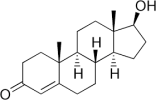
Creatine [structural formula shown below] may work through an additional mechanism and not just by increasing the amount of energy-generating phosphate groups in the muscles. According to sports scientists at Stellenbosch University, South Africa, creatine increases the amount of the androgenic testosterone metabolite DHT [structural formula also shown below] in the muscles. The researchers report this in the Clinical Journal of Sport Medicine.

In their article the South Africans describe an experiment they did with twenty rugby players, average age 19. Half of them took a placebo for three weeks. The other half were given creatine and glucose. The function of the glucose was to improve the uptake of creatine in the muscle cells.
The test subjects in the experimental group took a daily dose of 25 g creatine and 25 g glucose for the first week. In weeks 2 and 3 they took a daily 5 g creatine and 25 g glucose.
The bodies of the test subjects in the experimental group reacted to the creatine in the way you expect the bodies of serious athletes for whom weight training is not the core fitness activity to react. Their lean body mass increased slightly and their fat percentage decreased by a miniscule amount.

Nothing new so far. But when the researchers did a blood analysis of the hormone levels in the players, they made a discovery. At the end of the first week, during which the rugby players had taken 25 g of creatine a day, their DHT level had risen by 56 percent. In the following weeks, when they took a lower creatine dose, the subjects DHT level went down, but remained raised.

"This effect was a large increase in DHT rather than a marginal and possibly physiologically insignificant effect", write the South Africans.
The testosterone concentration in the test subjects blood remained constant. You expect the test subjects would also have produced less estradiol, but the South Africans dont mention estradiol at all in their article.
The researchers suspect that a creatine supplement increases the activity of the enzyme 5-alpha-reductase somewhere in the body. This enzyme converts testosterone into DHT, but exactly where this takes place the researchers dont know. Not in the muscles is all they can say for sure, as the muscles dont contain much 5-alpha-reductase.
Nor are the researchers sure whether the athletes build up more muscle fibre as a result of the metabolic change. This could be the case, they speculate. "Biochemical studies of androgen receptor affinity indicate that DHT is 4 times more biologically potent than testosterone", they write. The build up of muscle in creatine users, so often reported by sports scientists, may be partly due to endocrinal changes.
The scientists believe that their discovery is important for athletes. They warn of the potential side-effects of creatine, and argue that more research should be done on whether creatine increases the risk of baldness and benign enlargement of the prostate.
Source:
Clin J Sport Med. 2009 Sep;19(5):399-404.
In their article the South Africans describe an experiment they did with twenty rugby players, average age 19. Half of them took a placebo for three weeks. The other half were given creatine and glucose. The function of the glucose was to improve the uptake of creatine in the muscle cells.
The test subjects in the experimental group took a daily dose of 25 g creatine and 25 g glucose for the first week. In weeks 2 and 3 they took a daily 5 g creatine and 25 g glucose.
The bodies of the test subjects in the experimental group reacted to the creatine in the way you expect the bodies of serious athletes for whom weight training is not the core fitness activity to react. Their lean body mass increased slightly and their fat percentage decreased by a miniscule amount.

Nothing new so far. But when the researchers did a blood analysis of the hormone levels in the players, they made a discovery. At the end of the first week, during which the rugby players had taken 25 g of creatine a day, their DHT level had risen by 56 percent. In the following weeks, when they took a lower creatine dose, the subjects DHT level went down, but remained raised.

"This effect was a large increase in DHT rather than a marginal and possibly physiologically insignificant effect", write the South Africans.
The testosterone concentration in the test subjects blood remained constant. You expect the test subjects would also have produced less estradiol, but the South Africans dont mention estradiol at all in their article.
The researchers suspect that a creatine supplement increases the activity of the enzyme 5-alpha-reductase somewhere in the body. This enzyme converts testosterone into DHT, but exactly where this takes place the researchers dont know. Not in the muscles is all they can say for sure, as the muscles dont contain much 5-alpha-reductase.
Nor are the researchers sure whether the athletes build up more muscle fibre as a result of the metabolic change. This could be the case, they speculate. "Biochemical studies of androgen receptor affinity indicate that DHT is 4 times more biologically potent than testosterone", they write. The build up of muscle in creatine users, so often reported by sports scientists, may be partly due to endocrinal changes.
The scientists believe that their discovery is important for athletes. They warn of the potential side-effects of creatine, and argue that more research should be done on whether creatine increases the risk of baldness and benign enlargement of the prostate.
Source:
Clin J Sport Med. 2009 Sep;19(5):399-404.
Subscribe to:
Posts (Atom)


 Posts
Posts

